Best Web Search APIs for AI Agents in 2026 (Compared)
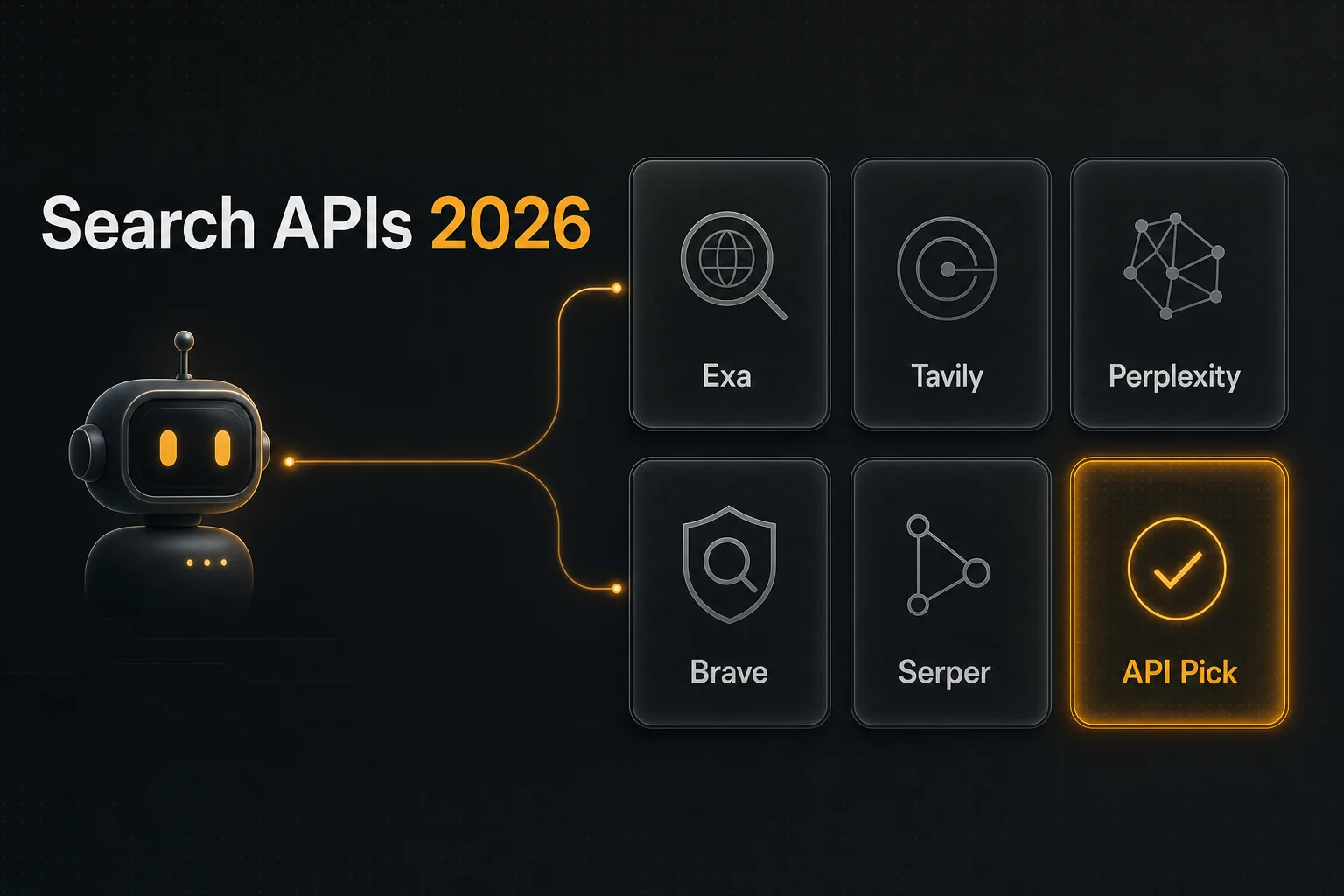
Bing Search retired in 2025 and a dozen agent-native search APIs rushed to replace it. Here is the practical, up-to-date map of who returns what, who charges how, and which one to wire into your agent.
TL;DR
- •The market split in two: agent-native search APIs (Exa, Tavily, Linkup, Parallel, API Pick) that return clean, ranked, LLM-ready text, and SERP-scraping APIs (Serper, SerpApi) that return raw Google results you clean yourself.
- •Microsoft retired the Bing Search API on August 11, 2025 — the single biggest reason teams are re-picking a search provider in 2026.
- •"Answer" endpoints (Perplexity Sonar, Brave Answers, Exa /answer) bundle an LLM call into search and cost more; pure search endpoints return faster and let you control the model.
- •Published list prices in 2026 cluster around $5–$10 per 1,000 searches for raw results; built-in model search (OpenAI, Anthropic) and Bing grounding sit at $10–$35 per 1,000.
- •For pay-as-you-go agent tool calling with only-on-success billing, API Pick Web Search is 15 credits (~$0.015) per call with no monthly floor.
Why does this list look different than it did a year ago?
Two things reshaped the web-search-API market between 2025 and 2026. First, Microsoft retired the Bing Search APIs on August 11, 2025 — the quiet workhorse behind a huge share of LLM grounding pipelines — and replaced it with Grounding with Bing Search inside Azure AI Foundry, which is not a drop-in API and bills around $35 per 1,000 transactions. Overnight, thousands of teams needed a new provider. Second, a wave of agent-native search startups raised serious money — Exa's $85M Series B at a ~$700M valuation, Parallel's $100M round, Linkup's seed — and shipped APIs designed for language models rather than humans.
The result is a market that splits cleanly into two camps, and the first decision you make is which camp you are in:
- Agent-native search (Exa, Tavily, Linkup, Parallel, Valyu, API Pick): you send a query and get back a short, ranked list of titles, URLs, and clean text snippets — sometimes a finished answer — already shaped for a context window.
- SERP scraping (Serper, SerpApi): you get the raw JSON of a Google results page and run your own cleaning, ranking, and snippet shaping.
Below is the practical map. Prices and quotas move fast — every figure here is a 2026 list price and you should confirm on each provider's pricing page before integrating.
Which web search APIs are worth testing?
Exa
The "search engine for AIs." Exa runs its own embeddings-based index and offers neural, keyword, and auto modes, plus /contents, /answer, /findSimilar, an async /research task endpoint, and the Websets list-builder. Strongest when topical similarity matters more than raw freshness. List price is roughly $7 per 1,000 searches with contents; a 1,000-request/month free tier lowers the barrier to trying it.
Tavily
The agent-native web-access layer — /search, /extract, /crawl, /map, and a newer /research endpoint. One call returns LLM-ready snippets plus an optional generated answer. It grew up inside the LangChain ecosystem and ships an official MCP server. Acquired by Nebius for $275M in February 2026; the brand continues. Credit-based: a basic search is 1 credit, advanced is 2, with a 1,000-credit/month free tier.
Perplexity Sonar
Not a raw-results API — Sonar returns a finished, cited answer. Models like sonar and sonar-pro bill in two parts: token cost plus a per-request search fee that scales with how much web context you pull. Best when you want the model's answer, not the links, and you are happy to let Perplexity choose the sources.
Linkup
A newer, independent search API focused on sourced answers, with standard and deep modes and a notable trick: pay-per-request via x402 / USDC micropayments so an autonomous agent can pay with no human account. Positions itself explicitly as a Bing-API replacement.
Parallel
Built ground-up for agents by ex-Twitter CEO Parag Agrawal. You give it a semantic objective and it returns compressed, token-relevant excerpts; the companion Task API returns validated structured data. Per-request pricing (a Base search tier around $4 per 1,000), benchmark-led positioning.
Brave Search API
One of the few genuinely independent global indexes — not a Google or Bing mirror — with a dedicated LLM Context endpoint for grounding. List price about $5 per 1,000 requests. Brave removed its free tier in 2025 and moved everyone to metered billing, which is why it shows up on every "Bing alternative" list.
Serper
The cheapest way to get raw Google SERP JSON at scale — roughly $0.30–$1 per 1,000 queries depending on volume. You ship the LLM-shaping layer yourself. Great if you already run a content extractor; hidden work if you don't.
API Pick Web Search
Pay-as-you-go semantic search shaped for tool calling. POST /api/search/web returns up to 5 ranked results — title, URL, and a pre-cleaned snippet — with optional country_code and start_date/end_date filters. 15 credits per call ($5 buys 5,000 credits, ≈ $0.015), credits never expire, and you are only charged on HTTP 200.
How do the search APIs compare side by side?
| Exa | Tavily | Perplexity Sonar | Brave | Serper | API Pick | |
|---|---|---|---|---|---|---|
| Camp | Agent-native (neural index) | Agent-native (web access) | Answer engine | Independent index | SERP scraping | Agent-native (tool-calling) |
| Returns | Ranked URLs + contents/highlights | Ranked snippets + optional answer | Finished cited answer | Web results + LLM Context | Raw Google SERP JSON | Ranked title + URL + clean snippet |
| List price / 1k (2026) | ~$7 (search + contents) | ~$8 basic / ~$16 advanced | ~$5–$14 + tokens | ~$5 | ~$0.30–$1 | 15 credits/call (~$15/1k) |
| Free tier | 1k req/mo | 1k credits/mo | Trial credits | $5/mo credit | 2.5k one-time | Free credits to start |
| Charges on failure? | Varies | Varies | Varies | Varies | Per query | No — only HTTP 200 |
| Tool schema endpoint | — | — | — | — | — | Yes — /api/search/web/tool-schema |
| Best fit | Semantic discovery | Hosted RAG / chat | Drop-in cited answers | Independent grounding | Custom SERP pipelines | Agent tool calling, no floor |
How do you choose a web search API?
Answer these in order and you will land on the right camp quickly.
- Do you want links or an answer? If you want a finished, cited answer and are fine letting the provider pick sources, use Perplexity Sonar (or an
/answerendpoint). If you want control over which sources your model reads, use a search API and run your own model. - Do you need raw SERPs? If your pipeline genuinely needs Google's full results page — knowledge panels, places, the exact ranking — use Serper or SerpApi and budget for your own cleaning step.
- Is similarity more important than freshness? "Find me more pages like this one" is Exa's home turf, thanks to neural ranking over its own index.
- Is your traffic bursty or your budget pay-as-you-go? If you are prototyping, run batch research jobs, or build agents that retry on transient failures, a per-call model with only-on-success billing (API Pick) avoids paying a monthly floor and avoids paying for retries.
What does the integration actually look like?
The lowest-friction integration is one where you paste a tool schema and skip the wrapper. Most of these APIs leave you to hand-write the JSON tool definition; API Pick publishes both shapes:
# Returns an OpenAI function definition AND a Claude tool-use definition
curl https://www.apipick.com/api/search/web/tool-schema
Wiring it into a Claude tool-use loop is then three lines:
import anthropic, requests

schema = requests.get("https://www.apipick.com/api/search/web/tool-schema").json()
client = anthropic.Anthropic()

response = client.messages.create(
    model="claude-sonnet-4-6",
    max_tokens=1024,
    tools=[schema["claude"]],
    messages=[{"role": "user", "content": "What shipped in agent search this week?"}],
)
A typical agent-native response is small enough to drop straight into a tool_result block:
{
  "results": [
    {
      "title": "Nebius acquires Tavily to add agentic search",
      "url": "https://nebius.com/newsroom/...",
      "snippet": "Nebius announced an agreement to acquire Tavily, adding\nagentic web search to its AI cloud platform."
    }
    /* …more */
  ],
  "result_count": 5,
  "credits_used": 15,
  "remaining_credits": 985
}
What do failed calls and retries actually cost?
Agents retry. A research agent that fans out ten searches will hit transient 429s and 502s, and a naive loop re-runs them. On a per-query biller, every retry costs money. On a subscription, every retry burns included credits faster than your dashboard suggests. The only model that ignores retries is only-on-success billing — you pay for the HTTP 200, not the three timeouts before it. For bursty agent traffic this is often a larger real-world saving than the headline per-call price.
What can none of these APIs do?
No web search API reliably answers "every document from this domain since 2019" — for deep-archive coverage you still pair search with a focused crawler or a domain-specific dataset. None of them perfectly dedupe near-identical URLs. And none of them fix the upstream problem of a stale or low-authority source; judging source quality is a decision your agent still has to make. Treat the search API as the retrieval primitive, not the whole brain.
Which one should you pick today?
Frequently Asked Questions
What is the best web search API for AI agents in 2026?
There is no single best — it depends on what you want back. For neural/semantic discovery over a custom index, Exa is strongest. For a one-call, LLM-ready RAG result with an optional bundled answer, Tavily fits. For a finished cited answer, Perplexity Sonar. For raw Google results you clean yourself, Serper is cheapest. For pay-as-you-go agent tool calling with pre-shaped JSON snippets, country/date filters, and billing only on HTTP 200, API Pick Web Search is the closest no-commitment option at 15 credits (~$0.015) per call.
Why did everyone start switching search APIs in 2025–2026?
Microsoft retired the Bing Search APIs on August 11, 2025, decommissioning the endpoints that powered a large share of LLM grounding pipelines. The replacement, "Grounding with Bing Search" inside Azure AI Foundry, is not a drop-in API and bills at about $35 per 1,000 transactions. That retirement pushed developers toward independent indexes (Brave) and agent-native startups (Exa, Tavily, Linkup, Parallel) and is the main catalyst behind the 2026 re-picking wave.
What is the difference between an agent-native search API and a SERP API?
A SERP API (Serper, SerpApi) returns the raw JSON of a Google results page — organic links, knowledge panels, ads — exactly as a human would see it, and you run your own cleaning and ranking. An agent-native search API (Exa, Tavily, Linkup, API Pick) returns a short ranked list of titles, URLs, and pre-cleaned text snippets sized for a context window, so it drops straight into a function-calling loop without a SERP parser.
How much do web search APIs cost per 1,000 calls in 2026?
Published list prices vary, so always confirm on the provider's page, but as a rough 2026 map: Brave ~$5, Tavily ~$8 (basic) / ~$16 (advanced) at pay-as-you-go, Exa ~$7 (search with contents), Perplexity Sonar ~$5–$14 plus tokens, Parallel ~$4–$9, Serper ~$0.30–$1 per 1,000 raw queries, and built-in OpenAI/Anthropic web search ~$10. API Pick Web Search is 15 credits per call at $5 / 5,000 credits (~$0.015), only deducted on success.
Do these search APIs work with OpenAI function calling and Claude tool use?
Yes. They all expose JSON-in / JSON-out, so any of them can be wrapped as a tool function. The difference is friction: API Pick publishes a ready-made schema at GET /api/search/web/tool-schema that returns both an OpenAI function definition and a Claude tool-use definition, so you paste it in rather than hand-writing the JSON.
Which search API is the best Bing Search API alternative?
It depends on what you used Bing for. For an independent global index closest in spirit to Bing, Brave Search API is the natural replacement. For LLM grounding specifically, Tavily, Exa, Linkup, and API Pick return text already shaped for a model, which Bing never did. If you want to avoid Azure's per-project setup and a monthly floor, API Pick is a pay-as-you-go drop-in.
APIs used in this article

Sarah Choy is the CEO of API Pick. She writes about building production-ready APIs for AI agents and LLM workflows.