Agentic Search vs SERP Scraping: Why Agents Need a Different API
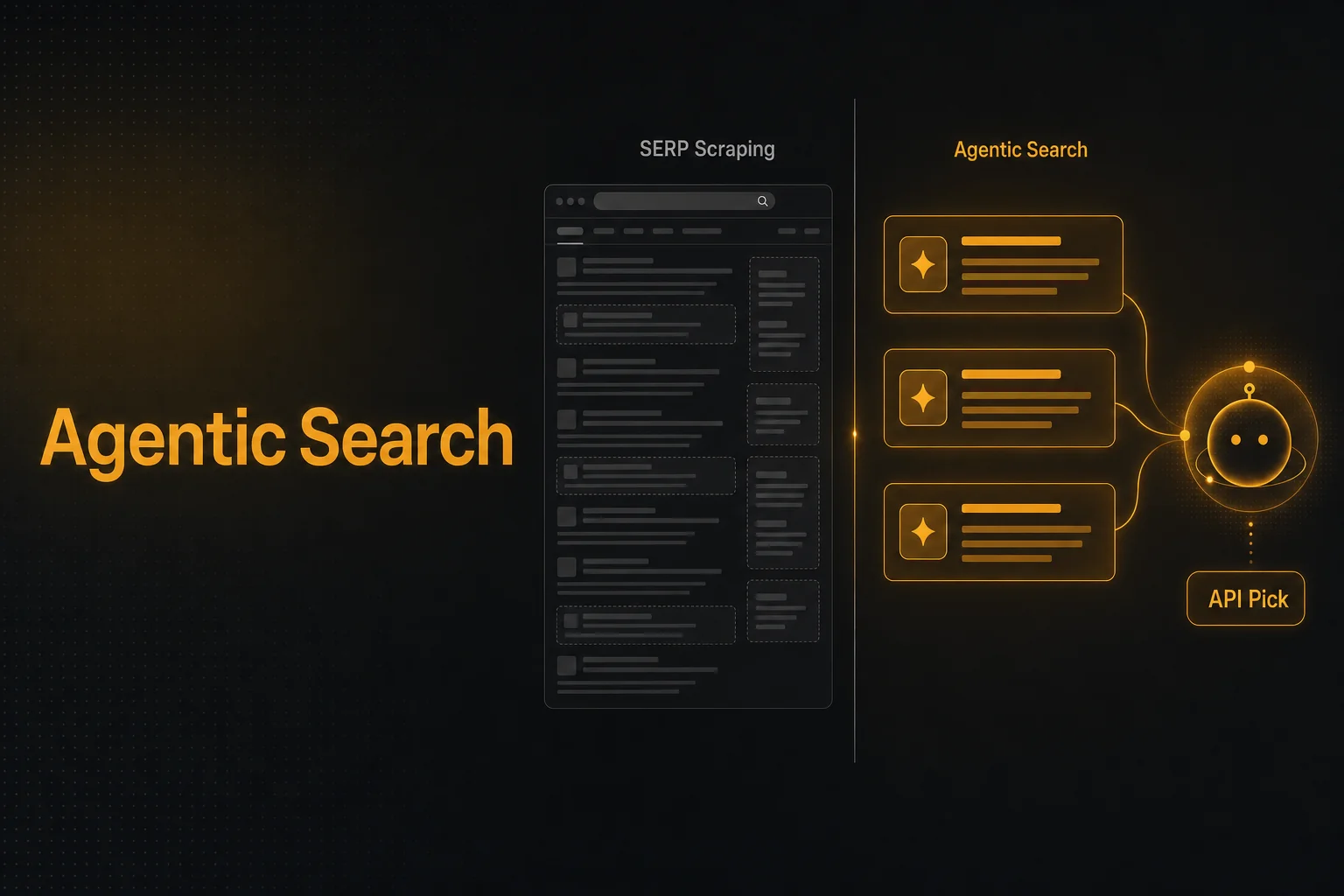
For twenty years, a search API meant 'scrape Google's results page.' AI agents broke that assumption. Here is what agentic search actually is, why it emerged, and when the old SERP model still makes sense.
TL;DR
- •Agentic search is web search designed to be consumed by an AI agent: you send a semantic objective and get back a short, ranked list of clean, citable text passages sized for a context window.
- •SERP scraping returns the raw HTML/JSON of a search-engine results page — built for humans and dashboards, not for language models.
- •The shift happened because LLMs reason over short ranked text, not over a SERP blob, and because Microsoft retired the Bing Search API in August 2025, forcing a market-wide re-pick.
- •Agentic search adds three things SERP APIs lack: pre-cleaned snippets, optional grounded answers, and agent-friendly billing (per-call, often only-on-success).
- •SERP scraping still wins when you genuinely need Google's full results page — rankings, knowledge panels, local packs — and run your own cleaning pipeline.
What is agentic search?
Agentic search is web search designed to be consumed by an AI agent rather than displayed to a human. You send a query — or a higher-level semantic objective — and you get back a short, ranked list of titles, URLs, and pre-cleaned text passages, sometimes a finished cited answer, already shaped to drop into a language model's context window.
That is a different product from what "a search API" meant for the previous twenty years. For two decades, a search API meant: give me the results page a human would see. That assumption is exactly what AI agents broke.
How does SERP scraping work?
A SERP (search engine results page) API returns the structured JSON of a Google or Bing results page — organic links, the knowledge panel, "people also ask," local packs, ads, shopping carousels. Tools like Serper and SerpApi do this extremely well and cheaply. The output is faithful to what a person sees in a browser:
{
  "organic": [
    { "position": 1, "title": "…", "link": "https://…", "snippet": "…" },
    { "position": 2, "title": "…", "link": "https://…", "snippet": "…" }
  ],
  "knowledgeGraph": { "title": "…", "type": "…", "description": "…" },
  "peopleAlsoAsk": [ /* … */ ],
  "relatedSearches": [ /* … */ ]
}
This is perfect for an SEO dashboard, a rank tracker, or a human-in-the-loop research tool. It is the wrong shape for a language model, for one blunt reason: a model cannot reason effectively over a SERP blob. It reasons over short, named, ranked text. Hand a model a full SERP and you are spending context tokens on layout metadata, ads, and "related searches" that have nothing to do with the answer.
How is agentic search different?
Agentic search throws away the SERP and returns only what an agent can use. The same query comes back as a compact, ranked list of clean passages:
{
  "results": [
    {
      "title": "Retrieval-augmented generation - Wikipedia",
      "url": "https://en.wikipedia.org/wiki/Retrieval-augmented_generation",
      "snippet": "Retrieval-augmented generation (RAG) combines search with\ntext generation, grounding LLM answers in retrieved documents."
    }
    /* …4 more, ranked */
  ],
  "result_count": 5,
  "credits_used": 15
}
This shape encodes three deliberate decisions that a SERP API leaves to you:
- Pre-cleaned snippets. The boilerplate — nav, cookie banners, ads — is stripped, so the model spends its context on signal.
- Ranking for relevance, not for ads. Results are ordered by usefulness to the query, not by a results-page layout that monetizes the top slots.
- A size budget. A handful of results, not a hundred, because context windows and token budgets are finite.
Why did agents outgrow SERP APIs?
Two forces converged in 2025–2026.
1. LLMs made the SERP format a liability
As soon as agents started calling search as a tool, the mismatch became obvious. Every token spent on SERP scaffolding is a token not spent on the actual sources, and every uncleaned page is a place for the model to get distracted or to quote a cookie banner. Teams found themselves writing a cleaning-and-ranking layer on top of every SERP API — which is precisely the layer agentic search bakes in.
2. Bing's retirement forced a re-pick
On August 11, 2025, Microsoft retired the Bing Search APIs, decommissioning the endpoints that had quietly grounded a large share of LLM pipelines. The replacement — Grounding with Bing Search inside Azure AI Foundry — is not a drop-in API and bills around $35 per 1,000 transactions. Thousands of teams had to choose a new provider at the exact moment a wave of agent-native startups shipped: Exa raised an $85M Series B, Parallel raised $100M, Tavily was acquired by Nebius for $275M, Linkup raised a seed. The category didn't just appear — it got funded and forced into the open.
SERP scraping vs agentic search: how do they compare?
| SERP scraping | Agentic search | |
|---|---|---|
| Returns | Raw results-page JSON | Ranked, clean, LLM-ready snippets |
| Built for | Humans, dashboards, rank tracking | AI agents, RAG, tool calling |
| Cleaning step | You build it | Included |
| Token efficiency | Low (layout + ads in payload) | High (signal only) |
| Answer mode | No | Often (bundled or separate /answer) |
| Raw price / 1k | ~$0.30–$1 | ~$5–$16 |
| Full-pipeline price | + your extractor + eng time | Closer than it looks |
| Best for | SEO, SERP features, custom pipelines | Grounding LLM answers in an agent |
What does each model actually cost per answer?
The sticker shock — "agentic search is 10x the price of Serper" — disappears when you price the whole pipeline. A SERP API gives you a results page; to feed a model you then run a content extractor on the chosen links, plus the engineering to build and maintain the cleaning and ranking logic. Agentic search folds that into the call. You are not paying 10x for the same thing; you are paying once for two steps instead of twice for two steps.
There is a second, sneakier cost: retries. Agents fan out and retry on transient failures. On a per-query SERP biller, every retry is billable. The cleanest defense is only-on-success billing — you pay for the HTTP 200, not the three timeouts before it. For bursty agent traffic, that single billing rule often saves more than the per-call price difference between providers.
How do you build on agentic search?
Because the output is already model-shaped, the integration is short. Pull a tool schema, hand it to your model, and let it call search as a tool:
import anthropic, requests

# Agentic search ships a ready-made tool definition — no hand-written JSON
schema = requests.get("https://www.apipick.com/api/search/web/tool-schema").json()
client = anthropic.Anthropic()

response = client.messages.create(
    model="claude-sonnet-4-6",
    max_tokens=1024,
    tools=[schema["claude"]],
    messages=[{"role": "user", "content": "What is agentic search, with sources?"}],
)
# The model calls /api/search/web, gets clean ranked snippets back,
# and answers with citations — no SERP parser anywhere in the loop.
That is the whole point of the category: the search API meets the agent where it already is, so the glue code that used to live in your codebase moves behind the endpoint.
So which should you use?
Frequently Asked Questions
What is agentic search?
Agentic search is web search built to be consumed by an AI agent rather than displayed to a person. You send a query or semantic objective, and the API returns a short, ranked list of titles, URLs, and pre-cleaned text snippets — sometimes a finished cited answer — already shaped to drop into a language model's context window. It contrasts with SERP scraping, which returns the raw results page a human would see.
How is agentic search different from a SERP API?
A SERP API (like Serper or SerpApi) returns the full JSON of a search-engine results page: organic links, ads, knowledge panels, local packs — the human-facing layout — and you do the cleaning, ranking, and snippet extraction yourself. An agentic search API (like Exa, Tavily, Linkup, or API Pick) skips the SERP entirely and returns clean, ranked, LLM-ready text. SERP APIs optimize for fidelity to Google; agentic search optimizes for direct use by a model.
Why did agentic search emerge in 2025–2026?
Two forces. First, LLMs reason poorly over a raw SERP blob but well over short, named, ranked passages — so a format built for humans became a liability for agents. Second, Microsoft retired the Bing Search API on August 11, 2025, which had quietly powered much of the LLM-grounding ecosystem, forcing thousands of teams to re-pick a provider just as agent-native startups (Exa, Tavily, Linkup, Parallel) shipped APIs designed for the new use case.
Is agentic search just RAG?
Not quite. RAG (retrieval-augmented generation) is the overall pattern of grounding an LLM's answer in retrieved documents. Agentic search is one way to do the retrieval half — specifically, live web retrieval shaped for an agent. You can build RAG over a private vector database with no web search at all, and you can use agentic search without classic RAG. They compose well, but they are different layers.
When should I still use a SERP scraping API?
Use a SERP API when your pipeline genuinely needs the structure of Google's results page — exact organic rankings for SEO monitoring, knowledge-graph panels, local/maps packs, shopping results — or when you already operate a content extractor and want the cheapest raw query. For grounding an LLM answer, an agentic search API that returns clean text removes a whole cleaning step.
Does agentic search cost more than SERP scraping?
Per raw query, SERP scraping is usually cheaper (Serper is roughly $0.30–$1 per 1,000). Agentic search APIs charge more per call (~$5–$16 per 1,000) because they also clean, rank, and shape the text — work you would otherwise pay for in your own extraction step and engineering time. Once you price the full pipeline, the gap narrows; and only-on-success billing (e.g. API Pick at 15 credits per HTTP 200) removes the cost of agent retries entirely.
APIs used in this article

Sarah Choy is the CEO of API Pick. She writes about building production-ready APIs for AI agents and LLM workflows.