What Is an API Aggregator? 4 Types Compared, With Code
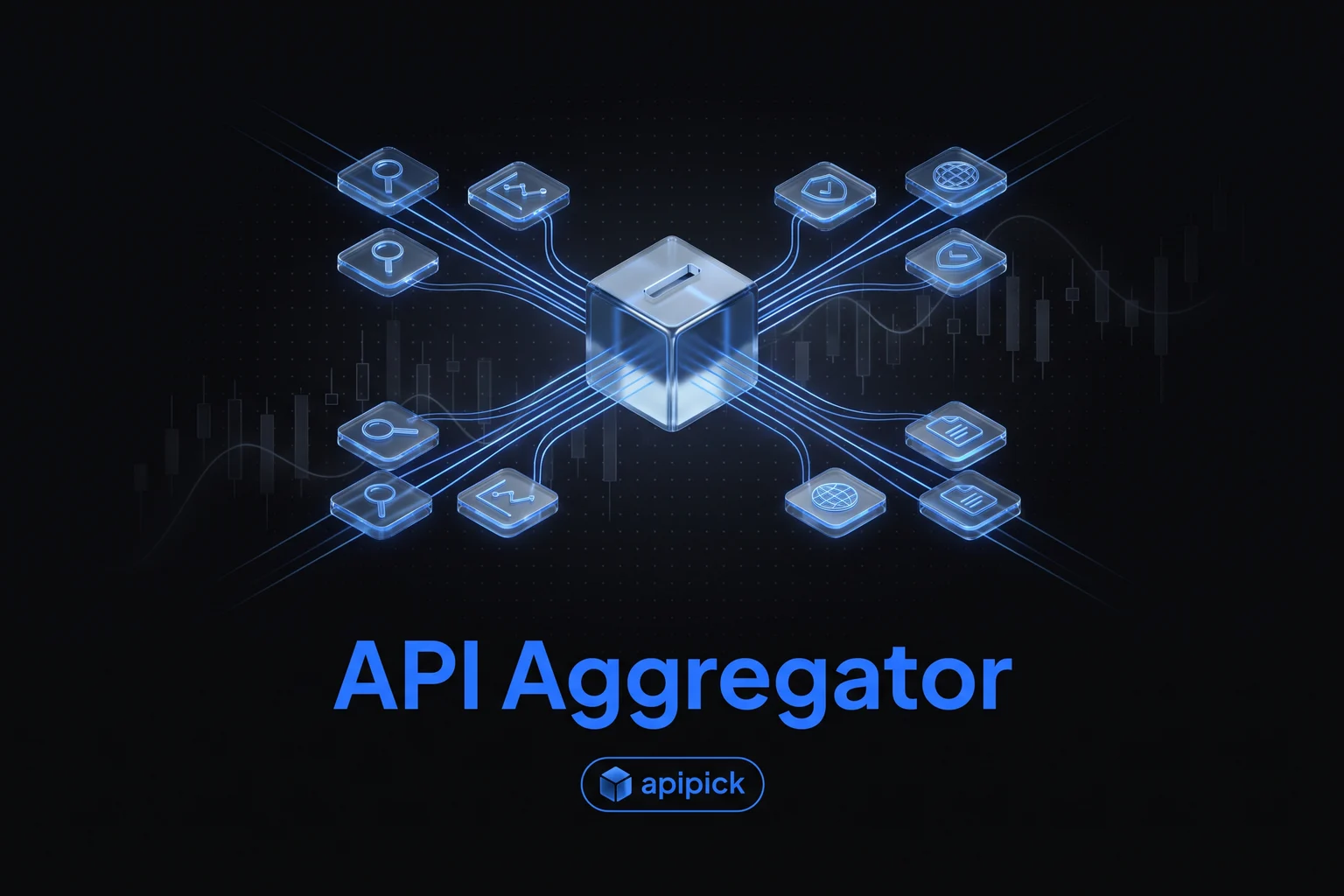
An API aggregator puts many third-party APIs behind one account, one key, one request format and one bill. The term covers four different products. Here is how to tell them apart, what each costs, and what a data API aggregator looks like from code.
TL;DR
- •An API aggregator is a service that puts many third-party APIs behind one account, one key, one request format and one bill, so you integrate once instead of once per provider.
- •Four different products use the name: unified APIs for SaaS records, open-banking aggregators for bank data, LLM routers for model calls, and data API aggregators for search, finance and registry data. The question that separates them is whose data you are reading.
- •An aggregator is not an API gateway. A gateway sits in front of APIs you own; an aggregator sits in front of APIs other companies own and holds those contracts for you.
- •For AI agents the gain is one secret, one tool format and one billing rule. On 2026-11-24 apipick's MCP server listed 27 tools that all answer to the same key.
- •Aggregators add a margin. If you call one API at high volume, going direct is usually cheaper.
An API aggregator is a service that puts many third-party APIs behind one account, one key, one request format and one bill, so you integrate once instead of once per provider. The name is used for four quite different products, and most bad choices come from buying the wrong kind.
We build apipick, a data API aggregator for developers and AI agents, so we have a stake in this. Competitor facts below are dated and linked, the code output is from real calls we made on 2026-11-24, and there is a section on when an aggregator is the wrong answer.
What does an API aggregator actually do?
It takes over the per-provider work you would otherwise repeat for every API: accounts, keys, request formats, errors and invoices. You talk to one service; it talks to the providers.
| Without an aggregator | With an aggregator |
|---|---|
| One account and contract per provider | One account |
| One secret per provider to store and rotate | One key |
| A different request and response shape per provider | One request style, normalised responses |
| Different error codes, retry rules and rate limits | One error format, one set of limits |
| One invoice per provider, often a subscription each | One balance or one bill |
| You find out a provider changed its API when your code breaks | The aggregator absorbs the change behind a stable endpoint |
The trade is simple: you give up some control and pay a margin, and in return the number of integrations you maintain drops from N to one.
What are the four types of API aggregator?
The four types are unified APIs, open-banking aggregators, LLM routers and data API aggregators, and the quickest way to tell which one you need is to ask whose data you are reading. If it is your customers' records in their own software, you want a unified API. If it is their bank accounts, an open-banking aggregator. If it is model output, an LLM router. If it is data the providers own, such as search results, filings or registries, a data API aggregator.
| Unified API | Open-banking aggregator | LLM router | Data API aggregator | |
|---|---|---|---|---|
| What you get back | Your customers' records from CRM, HR, accounting tools | Bank balances, transactions, identity | Model completions | Search results, filings, market data, registry lookups |
| Whose data | Your customer's, with their permission | The account holder's, with consent | Generated per request | The data provider's |
| Normalises | One software category into one schema | Many banks into one schema | Many model APIs into one chat format | Many sources into one call style and tool format |
| Examples | Merge, Apideck, Unified.to | Plaid, Tink | OpenRouter | Firecrawl Alexandria, apipick |
| Typical buyer | SaaS team shipping integrations | Fintech app | Team using several LLMs | Agent and app developers who need outside data |
These overlap less than the shared name suggests. A unified API will not give your agent a web search, and a data aggregator cannot read your customer's Salesforce. Firecrawl's own explainer, published 2026-11-23, draws the same line between data aggregators and unified APIs; we add the bank and model cases because they show up on the same search results page.
How is an API aggregator different from an API gateway?
An API gateway sits in front of APIs your own company runs; an API aggregator sits in front of APIs that other companies run. That one difference decides who holds the upstream contracts and who gets paged when a provider changes something.
| API gateway | API aggregator | API marketplace | |
|---|---|---|---|
| Whose APIs | Yours | Other companies' | Other companies' |
| Who holds the upstream accounts | You | The aggregator | Usually you, one per listing |
| Response format | Whatever your services return | Normalised by the aggregator | Whatever each listed API returns |
| Billing | Your infrastructure cost | One bill from the aggregator | Varies by listing |
| Main job | Routing, auth, rate limits, observability | Consolidating access to outside data or services | Discovery |
The marketplace column matters because it is the most common confusion. A marketplace helps you find APIs; an aggregator also removes the per-provider work after you find them.
Why do AI agents need an API aggregator?
Because an agent's tool list is its integration list, and every extra provider adds a secret to the agent's environment, a schema to its context and a billing rule to its failure modes. An aggregator turns that into one key, one tool format and one billing rule.
Four things change for agents in particular:
- Discovery. An agent can only use tools it can see. Aggregators that publish machine-readable tool definitions, an MCP server or an
llms.txtlet the agent, or the coding assistant wiring it up, load the whole catalog at once. - One secret. A key that reaches 27 tools is one thing to scope, store and rotate. Twenty-seven keys are twenty-seven chances to leak one.
- Retries. Agents retry. If a provider bills failed attempts, a loop that retries a timeout five times pays five times. We argued for charging only on success for exactly this reason, and apipick bills only HTTP 200 responses.
- Uniform shapes. When every tool returns compact JSON in a predictable layout, the model spends fewer tokens parsing and makes fewer mistakes chaining results.
What does a data API aggregator look like from code?
One base URL, one key header and one tool format across every category. Here is apipick from the outside. Everything in steps 1 and 2 works without an API key, so you can run it before signing up; the outputs shown are from our run on 2026-11-24.
1List every tool over MCP
The apipick MCP server answers tools/list without a key:
curl -s -X POST https://www.apipick.com/mcp \
  -H 'content-type: application/json' \
  -H 'accept: application/json, text/event-stream' \
  -d '{"jsonrpc":"2.0","id":1,"method":"tools/list"}' \
| jq '.result.tools | length'27The 27 tools span web and news search, cited answers, URL extraction, finance (markets, financials, SEC filings, earnings calendar, economic data, prediction markets), science and health, law and policy, cybersecurity, WHOIS/RDAP, LEI, EU VAT and dependency scanning. The REST API has more: the API catalog lists 35 endpoints, including utilities such as email validation, IP geolocation and public holidays that are not exposed as MCP tools.
2Read the tool schemas in one shape
Every search and lookup endpoint publishes its tool definition at <endpoint>/tool-schema, in both OpenAI and Anthropic formats, with the credit cost attached. One loop reads five tools from four categories:
import requests

BASE = "https://www.apipick.com"
# One tool from each category. Tool schemas are public: no key needed.
paths = [
    "/api/search/web",           # search
    "/api/search/sec",           # finance
    "/api/scan-dependencies",    # security
    "/api/validate-vat",         # open data (VIES)
    "/api/lei-lookup",           # open data (GLEIF)
]

for p in paths:
    s = requests.get(f"{BASE}{p}/tool-schema", timeout=20).json()
    tool = s["openai"]["function"]
    required = tool["parameters"].get("required", [])
    print(f'{tool["name"]:<22} {s["credits_per_call"]:>4} credits  required={required}')
web_search 15 credits required=['query']
sec_search 120 credits required=['query']
scan_dependencies 5 credits required=['packages']
validate_eu_vat 3 credits required=['vat_number']
lei_lookup 3 credits required=[]lei_lookup has no required field because it takes either lei or name. Because the schema shape is the same for every tool, you can pass s["openai"] straight into OpenAI function calling or s["anthropic"] into Claude tool use.
3Call any tool with the same key
Paid calls need a key from the dashboard; new accounts get 100 free credits. The header is the same whether you search the web or look up a domain:
export APIPICK_KEY=pk_yourkey

# Web search: 15 credits
curl -s -X POST https://www.apipick.com/api/search/web \
  -H "x-api-key: $APIPICK_KEY" -H 'content-type: application/json' \
  -d '{"query": "what is an api aggregator", "max_num_results": 3}'

# WHOIS / RDAP: 2 credits
curl -s "https://www.apipick.com/api/whois?query=apipick.com" \
  -H "x-api-key: $APIPICK_KEY"
The same in Python, as one helper for every endpoint:
import os
import requests

BASE = "https://www.apipick.com/api"
HEADERS = {"x-api-key": os.environ["APIPICK_KEY"]}

def call(path, *, json=None, params=None):
    method = "POST" if json is not None else "GET"
    r = requests.request(method, f"{BASE}{path}", headers=HEADERS,
                         json=json, params=params, timeout=60)
    r.raise_for_status()  # non-200 responses are never charged
    return r.json()

results = call("/search/web", json={"query": "what is an api aggregator", "max_num_results": 3})
domain  = call("/whois", params={"query": "apipick.com"})
vat     = call("/validate-vat", params={"vat_number": "IE6388047V"})
Real responses from 2026-11-25, trimmed: long snippets are shortened, extra results and contacts are cut, and the account balance field is removed.
POST /api/search/web  (15 credits)
{
  "query": "what is an api aggregator",
  "results": [
    {
      "title": "API Aggregator: What It Is, How It Works, and How to Choose One",
      "url": "https://www.apideck.com/blog/api-aggregator",
      "snippet": "…Learn what an API aggregator is, how it works under the hood, and what to look for when choosing one. Covers open banking, accounting, HRIS, and CRM aggregators.…",
      "source_type": "website",
      "published_at": null,
      "score": 0.97,
      "data_type": "unstructured"
    }
    … 2 more: apidog.com/blog/api-aggregator/, rajeshkumar.xyz/blog/api-aggregators/
  ],
  "result_count": 3,
  "credits_used": 15
}

GET /api/whois?query=apipick.com  (2 credits)
{
  "query": "apipick.com",
  "type": "domain",
  "found": true,
  "registrar": "NameCheap, Inc.",
  "registered_at": "2025-05-12T06:52:14Z",
  "expires_at": "2028-05-12T06:52:14Z",
  "status": ["client transfer prohibited"],
  "nameservers": ["dns1.registrar-servers.com", "dns2.registrar-servers.com"],
  "dnssec": false,
  "source": "RDAP (IANA bootstrap via rdap.org)",
  "credits_used": 2
}

GET /api/validate-vat?vat_number=IE6388047V  (3 credits)
{
  "vat_number": "IE6388047V",
  "country_code": "IE",
  "valid": true,
  "name": "GOOGLE IRELAND LIMITED",
  "address": "3RD FLOOR, GORDON HOUSE, BARROW STREET, DUBLIN 4",
  "source": "European Commission VIES",
  "credits_used": 3
}
Every response reports credits_used, so an agent can track spend per step. Full field references are on each endpoint's page, for example web search and WHOIS lookup. What happens without a key is also part of the contract. This is the real response from 2026-11-24:
curl -s -w '\nHTTP %{http_code}\n' -X POST https://www.apipick.com/api/search/web \
  -H 'content-type: application/json' -d '{"query":"what is an api aggregator"}'
{"error":"API key required. Provide 'x-api-key' or 'Authorization: Bearer <token>'."}
HTTP 401Over MCP, a tools/call without a key comes back as a tool error the agent can read, rather than a transport failure:
{"jsonrpc":"2.0","id":2,"result":{"isError":true,"content":[{"type":"text","text":"apipick API key required. Add the header `Authorization: Bearer <your key>` to this MCP server's configuration. Get a free key with 100 credits at https://www.apipick.com/dashboard/api-keys"}]}}Neither costs anything: only HTTP 200 responses draw on the balance.
To give a coding agent the whole catalog in one line:
claude mcp add --transport http apipick https://www.apipick.com/mcp \
  --header "Authorization: Bearer pk_yourkey"
How much does an API aggregator cost?
You pay a margin over going direct, and the pricing model matters as much as the price: prepaid or subscription, whether credits expire, and whether failed calls are billed. Here is how three aggregators of different types price on 2026-11-24.
| apipick | Firecrawl | OpenRouter | |
|---|---|---|---|
| Type | Data API aggregator | Data API aggregator (Alexandria) plus scraping | LLM router |
| Pricing model | Prepaid credits, $1 = 1,000 credits | Monthly plans with a credit allowance | Model list prices plus a fee on credit purchases |
| Free allowance | 100 credits once, no card | 1,000 credits a month | 25+ free models |
| Entry paid option | $5 pack (5,000 credits) | Hobby: $19 a month, or $16 a month billed annually, for 5,000 credits | 5.5% fee on credits on the Standard plan |
| Expiry | Credits never expire | Monthly allowance per plan | Not covered here |
| Failed calls | Not charged (only HTTP 200 is billed) | Not stated on the pricing page | Not covered here |
Sources: apipick pricing, Firecrawl pricing, Firecrawl's API aggregator post (which lists SEC EDGAR filings at 5 credits per call), OpenRouter pricing. All read on 2026-11-24.
To make credits concrete, here is one agent research step on apipick priced from the per-endpoint cost table:
| Call | Credits | Dollars |
|---|---|---|
| 1 web search | 15 | $0.015 |
| 1 SEC filings search | 120 | $0.120 |
| 2 WHOIS lookups | 4 | $0.004 |
| 1 EU VAT check | 3 | $0.003 |
| Total | 142 | $0.142 |
Doing the same with four direct integrations means four accounts, four keys and four sets of terms to read before the first call.
What should you check before choosing an API aggregator?
Check the type first, then the billing rules, then what happens when an upstream breaks. Those three decide most of the long-run cost.
| Question | Why it matters | apipick's answer |
|---|---|---|
| Whose data do I need? | Picks the type (see the four-type table) | Provider-owned data: search, finance, science, law, security, registries |
| Is a failed call billed? | Agents retry; billed retries multiply cost | No. Only HTTP 200 is charged |
| Do credits expire or reset monthly? | Unused allowance is a hidden price | Never expire |
| Is there a machine-readable catalog? | Agents and coding assistants wire tools from it | MCP server, /tool-schema per endpoint, llms.txt |
| What happens when an upstream breaks? | You find out whether the margin buys anything | The endpoint returns 503 and is not charged. On 2026-11-24 our three NCBI genomics endpoints were in that state while their upstream index is rebuilt |
| Can I see the sources behind each tool? | You need to know what you are citing | Each tool page names its sources, for example SEC EDGAR or GLEIF |
| Is there a cap per call? | Affects how many calls a task needs | Web and news search return at most 5 results per call |
When is an API aggregator the wrong choice?
When you call one API at high volume, when you need your users' own data, or when you need every raw field a provider returns. In those cases go direct or use a different type.
- One API, high volume. The aggregator margin is paid on every call. Our web search costs $15 per 1,000 calls, which is more than several single-purpose search APIs list; our Tavily alternatives and Google Custom Search alternatives posts have the price tables. If search is all you need at millions of calls a month, a direct contract wins.
- Your customers' SaaS records. apipick does not connect to anyone's CRM or HR system. Use a unified API.
- Bank data. Use an open-banking aggregator with a consent flow; data aggregators do not have one.
- Routing between LLMs. apipick does not proxy model calls. Use an LLM router or the model providers directly.
- Every upstream field and an upstream SLA. Aggregators normalise responses, which means some provider-specific fields are dropped, and your service level is the aggregator's, not the provider's.
If that matches, start from the API catalog or connect the MCP server; 100 free credits are enough to try a handful of tools before paying.
Frequently Asked Questions
What is an example of an API aggregator?
Plaid is the classic example for bank data, Merge and Apideck for SaaS integrations (they call themselves unified APIs), OpenRouter for LLM models, and Firecrawl Alexandria or apipick for search, finance and public-registry data. They solve different problems even though they share the name.
What is the difference between an API aggregator and an API gateway?
An API gateway sits in front of APIs your own company runs and handles routing, authentication and rate limits for them. An API aggregator sits in front of APIs that other companies run: it holds the upstream accounts and contracts, maps their schemas into one format and bills you once.
Is a unified API the same as an API aggregator?
A unified API is one kind of API aggregator. It normalises one software category, such as CRM or HR systems, into a single schema and reads your customers' own records with their permission. A data API aggregator returns data the providers own, such as search results, filings or registry entries.
Can AI agents use an API aggregator through MCP?
Yes. Several aggregators expose their catalog as a Model Context Protocol server, so an agent such as Claude Code or Cursor gets every tool from one connection and one key. apipick's MCP server at https://www.apipick.com/mcp listed 27 tools on 2026-11-24, and tools/list works without a key.
How much does an API aggregator cost?
It depends on the type. Data API aggregators usually sell credits: apipick is prepaid at $1 for 1,000 credits with no expiry and charges only HTTP 200 responses, and on 2026-11-24 Firecrawl's paid plans started at $19 a month for 5,000 credits. LLM routers charge a fee on top of model prices; OpenRouter listed 5.5% on credit purchases for its Standard plan.
Do I need a separate API key for each provider?
Not with a data API aggregator. With apipick, one key in the x-api-key header (or Authorization: Bearer) works for every REST endpoint and every MCP tool, and every call draws on the same credit balance.

Sarah Choy is the CEO of apipick. She writes about building production-ready APIs for AI agents and LLM workflows.