USPTO ODP API: /patent/applications/search, Auth + Python
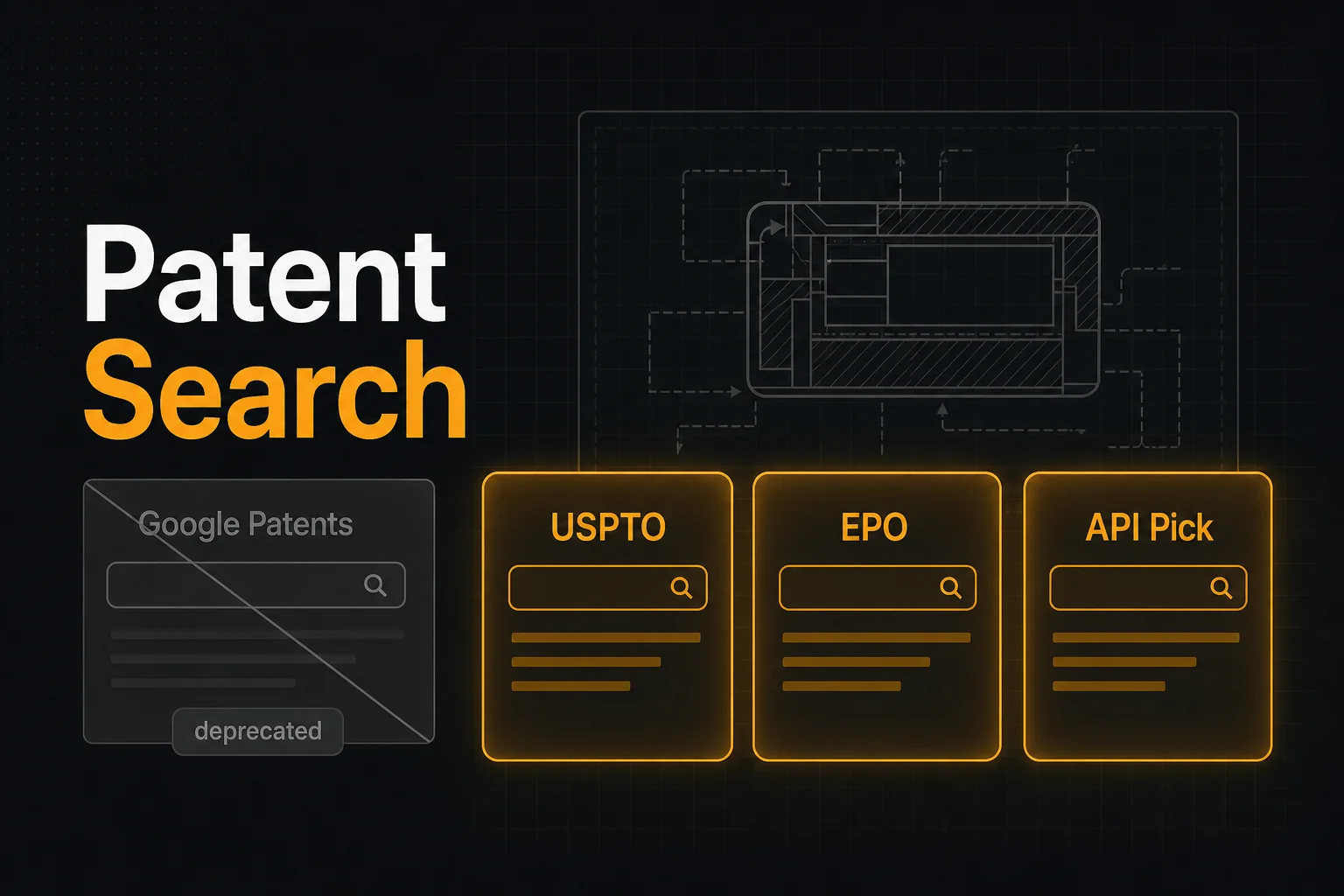
Google Patents Public Datasets retired without a documented replacement, and the USPTO migrated PEDS into a new Open Data Portal mid-2026, breaking pipelines on the way. Here's what actually works in 2026 for prior-art, FTO, and IP-research workloads — six alternatives, side by side.
TL;DR
- •Google Patents Public Datasets API was deprecated; there is no first-party Google replacement for programmatic patent search.
- •USPTO replaced legacy PEDS with the Open Data Portal (ODP) — full-text and metadata for US filings, REST + JSON, free.
- •EPO OPS is the most authoritative for international families but returns XML and is rate-limited.
- •PatentsView (USPTO-funded) is great for metadata and disambiguation but lacks full-text claims.
- •API Pick Patent Search wraps semantic retrieval over USPTO + EPO + WIPO + JPO + KIPO + CNIPA in one POST endpoint, JSON in / JSON out, 80 credits per call.
What changed and why this post exists
Two things broke in the patent-search API ecosystem between 2024 and 2026, and they broke at the same time.
First, the Google Patents Public Datasets keyword-search API — the de facto default for indie devs doing prior-art and competitive intel work — stopped being maintained. The BigQuery patents-public-data dataset is still there for bulk analytics, but the simple https://patents.googleapis.com/... endpoints that powered most weekend-project patent tools are gone. Search for "Google Patents API alternative 2026" and you'll find a hundred Stack Overflow questions and zero answers.
Second, the USPTO retired the legacy Patent Examination Data System (PEDS) at the end of 2024 and is migrating remaining bulk endpoints to the new Open Data Portal (ODP) by May 29, 2026. Pipelines that scraped PEDS XML responses started breaking in early 2025; teams that didn't migrate by Q1 2026 are quietly broken now.
Both events happened around the same time AI-for-IP startups (Solve Intelligence, Patlytics, NLPatent, IPRally, &AI) raised serious money — Solve Intelligence alone closed a $40M Series B for AI patent search and drafting. Demand has never been higher; the supply side just got messier.
Here are the six APIs that actually work in 2026, what each is good at, and where each falls short.
The six options
1. USPTO Open Data Portal (ODP)
The official US replacement for PEDS. REST + JSON, free, covers patent applications, granted patents, and assignment data from the United States Patent and Trademark Office. Full-text available. Documentation on developer.uspto.gov.
Strengths: authoritative, free, covers full text. Weaknesses: US-only (you'll still need EPO OPS or others for international), schema changes during the migration window have broken some pipelines, no semantic search — keyword/Boolean only.
2. EPO OPS (Open Patent Services)
The European Patent Office's developer API. Covers EP, WO, and many national filings via the INPADOC database. Authoritative for international family lookups and PCT data.
Strengths: best international coverage, includes legal status and family info. Weaknesses: returns XML (heavy parsing), free tier capped at 500MB/week, separate fulltext endpoint, OAuth flow for higher tiers. Steep learning curve for first-time integrators.
3. PatentsView
USPTO-funded research tool. Strong on metadata: assignee disambiguation, inventor profiles, citation networks, government-interest funding. Free.
Strengths: clean disambiguated entities, easy REST + JSON. Weaknesses: no full-text claims body, US-focused, lag behind real-time filings, not optimized for semantic similarity search.
4. Lens.org
Aggregator covering 95M+ patents from 100+ jurisdictions plus scholarly works. Used by IP analysts and academic researchers. Free academic tier; commercial tier billed.
Strengths: broadest jurisdiction coverage, links patents to scholarly literature, good UI for human follow-up. Weaknesses: commercial pricing opaque, semantic search is keyword-augmented rather than embedding-native.
5. PQAI (Project PQAI)
Open-source patent-search project run by AT&T's IP team. Free, semantic similarity over USPTO + EPO. Popular with the indie / r/LocalLLaMA crowd — see the DEV.to "I posted my patent search AI to Reddit and got 65 upvotes" write-up that surfaced this corner of the ecosystem.
Strengths: free, semantic-first, no API key needed for moderate volume. Weaknesses: best-effort uptime, no SLA, smaller jurisdictional coverage, no commercial support.
6. API Pick Patent Search
Semantic search over USPTO + EPO + WIPO + JPO + KIPO + CNIPA in a single REST call. JSON in / JSON out, 80 credits per call (~$0.08 at $5 / 5,000 credits), only-on-success billing. Returns title, abstract, snippet, URL, jurisdiction, and assignee for each hit.
Strengths: one endpoint covering all major offices, ranked semantic results pre-shaped for LLM consumption, predictable per-call pricing. Weaknesses: less configurable than direct EPO OPS for legal-status edge cases; if you need bulk dataset analytics, BigQuery is still better than per-call APIs.
Side by side
| USPTO ODP | EPO OPS | PatentsView | Lens.org | PQAI | API Pick | |
|---|---|---|---|---|---|---|
| Coverage | US only | EP + WO + many national via INPADOC | US only | 100+ jurisdictions | USPTO + EPO | USPTO + EPO + WIPO + JPO + KIPO + CNIPA |
| Full-text claims | Yes | Yes (separate endpoint) | No (metadata only) | Yes (commercial) | Yes | Yes (snippet) |
| Search type | Keyword/Boolean | Keyword/Boolean | Field-filtered | Keyword + faceted | Semantic | Semantic |
| Format | JSON | XML | JSON | JSON | JSON | JSON |
| Pricing | Free | Free 500 MB/wk + paid | Free | Free academic + paid | Free | $5 / 5,000 credits, 80/call |
| Best fit | US gov-grade source | International families & legal status | Assignee/inventor metadata | Aggregated multi-jurisdiction analytics | Open-source semantic exploration | Production AI agents, prior-art / FTO |
Working code: same prior-art query, six ways
The example query: "wireless charging coil with embedded ferrite for under-display sensors." A real FTO-shaped question.
USPTO ODP
import requests

# Open Data Portal — keyword/Boolean
r = requests.get(
    "https://api.uspto.gov/api/v1/patent/applications/search",
    headers={"X-Api-Key": "YOUR_USPTO_ODP_KEY"},  # required — get a key at developer.uspto.gov
    params={
        "query": "wireless charging coil ferrite under-display",
        "fields": "applicationNumber,inventionTitle,filingDate,abstractText",
        "limit": 25,
    },
)
print(r.json()["results"][:3])
EPO OPS
import requests
from base64 import b64encode

# OAuth: token from Consumer Key + Secret
auth = b64encode(b"YOUR_KEY:YOUR_SECRET").decode()
token = requests.post(
    "https://ops.epo.org/3.2/auth/accesstoken",
    headers={"Authorization": f"Basic {auth}"},
    data={"grant_type": "client_credentials"},
).json()["access_token"]

# Then search
r = requests.get(
    "https://ops.epo.org/3.2/rest-services/published-data/search",
    params={"q": 'ti="wireless charging coil ferrite"'},
    headers={"Authorization": f"Bearer {token}", "Accept": "application/xml"},
)
# Returns XML — you'll need lxml or xmltodict
print(r.text[:500])
PatentsView
import requests

r = requests.post(
    "https://search.patentsview.org/api/v1/patent/",
    headers={"X-Api-Key": "YOUR_KEY"},
    json={
        "q": {"_text_phrase": {"patent_title": "wireless charging coil"}},
        "f": ["patent_id", "patent_title", "patent_date", "assignees"],
        "o": {"size": 25},
    },
)
print(r.json()["patents"][:3])
Lens.org
import requests

# Lens uses Lucene-style queries; commercial endpoints require paid token
r = requests.post(
    "https://api.lens.org/patent/search",
    headers={"Authorization": "Bearer YOUR_TOKEN"},
    json={
        "query": {
            "match": {
                "full_text": "wireless charging coil ferrite under-display sensor"
            }
        },
        "size": 25,
    },
)
print(r.json()["data"][:3])
PQAI
import requests

r = requests.get(
    "https://api.projectpq.ai/patents/",
    params={
        "q": "wireless charging coil with embedded ferrite for under-display sensors",
        "n": 10,
    },
)
print(r.json()["results"][:3])
API Pick Patent Search
import requests

r = requests.post(
    "https://www.apipick.com/api/search/patents",
    headers={"x-api-key": "pk_yourkey"},
    json={
        "query": "wireless charging coil with embedded ferrite for under-display sensors",
    },
)
print(r.json()["results"][:3])
# Each result: { title, abstract, snippet, url, jurisdiction, assignee }
# Ranked by semantic similarity. 80 credits, only on HTTP 200.
How to choose, by use case
Where this is going
AI-for-IP is one of the fastest-moving software verticals right now. Within 18 months the assumption of "patent search = enter a Boolean query into a UI" will look as old-fashioned as "code search = enter regex into grep". The teams shipping working products today are the ones who paid the migration tax in 2025 — set up resilient programmatic access, layered semantic retrieval, and built a cleanup pipeline for the inevitable schema churn from public sources.
For most production AI agents you don't need to choose one API — you need a sensible default with predictable pricing and the option to drop down to a lower-level source for edge cases. That's why we built API Pick Patent Search as a single semantic endpoint over the major offices: it covers 95% of agent workloads and the remaining 5% can call EPO OPS or USPTO ODP directly. The companion URL Extract picks up where any of these leaves off — fetching the full text of a specific filing for deep claim analysis.
Frequently Asked Questions
Is the Google Patents Public Datasets API really gone?
The BigQuery dataset still exists for bulk analytics, but the keyword-search API endpoint developers used in 2018-2022 is no longer maintained or documented. There is no first-party Google replacement. The web search at patents.google.com works for humans but is not designed for programmatic access — scraping it triggers anti-bot protection within minutes.
Which alternative gives me full-text claims?
USPTO Open Data Portal returns full-text for US filings (10-Q-like detail). EPO OPS returns full-text for European filings via a separate fulltext endpoint. PatentsView gives you metadata only — no claims body. API Pick Patent Search returns title, abstract, claims, and a snippet pre-shaped for LLM consumption across all major offices.
What's the simplest way to do a freedom-to-operate (FTO) search programmatically?
The minimum viable FTO loop: (1) extract key technical concepts from your invention description, (2) semantic-search a multi-jurisdiction patent corpus, (3) for hits with high similarity, pull full claims and run a relevance check with an LLM, (4) cluster by patent family to dedupe equivalents. API Pick Patent Search covers steps 2-3 in one call across USPTO + EPO + WIPO; combine with URL Extract or company-fact lookup for assignee context.
What does an FTO search actually cost on each option?
USPTO ODP and PatentsView are free but rate-limited and require a lot of glue code. EPO OPS has a free tier (500MB/week) plus paid; XML parsing is heavy. Lens.org has a free academic tier and paid commercial. PQAI is free for academic / hobbyist research. API Pick Patent Search is 80 credits per call (~$0.08 at list price) covering all major offices in one request — the engineering cost dominates over the API cost in every case.
Can I rely on these for legal opinions?
No API output should be presented as a legal opinion. Patent searches inform attorney work; they don't replace it. For litigation-grade prior-art (e.g. PTAB invalidity), pair API-driven recall with attorney-led precision review and certified search firms. For competitive-intelligence and engineering-team workflows, programmatic search is the right tool.
APIs used in this article

Sarah Choy is the CEO of API Pick. She writes about building production-ready APIs for AI agents and LLM workflows.